 +1 (844) 444-7456 |

Fluid Structure Interaction
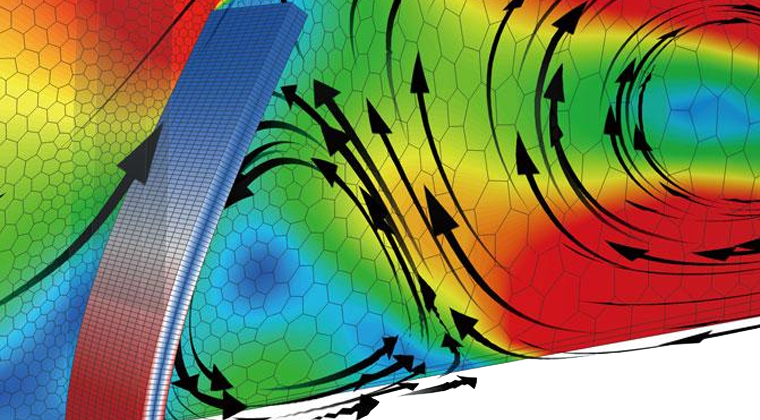
We perform coupled Fluid–Structure Interaction (FSI) simulations that combine Computational Fluid Dynamics (CFD) and Finite Element Analysis (FEA) to evaluate how fluid forces interact with structural components under real operating conditions. Our analyses help improve reliability, optimize designs, and investigate complex engineering failures.
What We Analyze
Our FSI simulations evaluate the interaction between fluid flow and structural response to predict deformation, vibration, pressure loading, and dynamic behavior across complex engineering systems.
Pressure-Induced Deformation

Aeroelastic Analysis

Hydroelastic Analysis
Flow-Induced Vibration

Thermal-Structural Coupling

Dynamic Fluid Loading
Why
Fluid–Structure Interaction?
Many engineering problems cannot be accurately solved by analyzing fluids or structures independently. FSI combines CFD and FEA into a single coupled simulation, enabling engineers to evaluate real-world interactions between fluid forces and structural behavior, resulting in more reliable designs, better performance, and improved failure prediction.
Applications
- Aeroelastic Analysis
- Hydroelastic Systems
- Flow-Induced Vibration
- Pressure & Structural Loading
- Thermal–Structural Interaction
- Failure Investigation
Aeroelastic Analysis
Evaluate how aerodynamic forces interact with structural components to predict deformation, vibration, flutter, and stability under varying operating conditions.
Common Applications
- Aircraft wings
- UAV structures
- Wind turbine blades
- Automotive aerodynamics
- Rotor blades
- Lightweight structures
Hydroelastic Systems
Analyze fluid-structure interaction within marine and offshore systems to evaluate structural response under wave loading, water pressure, and dynamic fluid conditions.
Common Applications
- Ship hulls
- Offshore platforms
- Marine propellers
- Underwater structures
- Coastal infrastructure
- Hydraulic systems
Compressor & Turbine Performance
Predict vibration caused by fluid flow interacting with structural components to improve durability, reduce fatigue, and prevent vibration-related failures.
Common Applications
- Heat exchangers
- Pipelines
- Tube bundles
- Valves
- Industrial piping
- Process equipment
Internal Flow Optimization
Evaluate structural deformation caused by pressure loads and transient fluid events to improve component integrity and operational safety.
Common Applications
- Pressure vessels
- Tanks
- Pipelines
- Hydraulic equipment
- Industrial machinery
- High-pressure systems
Thermal–Structural Interaction
Analyze the combined effects of fluid flow, heat transfer, and structural deformation to improve thermal performance and long-term reliability.
Common Applications
- Electronic cooling
- Heat exchangers
- Power systems
- Turbomachinery
- Thermal expansion
- High-temperature equipment
Failure Investigation
Use coupled FSI simulations to reconstruct complex engineering failures involving fluid loading, structural response, vibration, and pressure-induced damage.
Common Applications
- Structural failures
- Pipe failures
- Turbine failures
- Pressure equipment
- Fatigue investigations
- Root cause analysis