 +1 (844) 444-7456 |

Forced Response Analysis
We perform forced response analysis to evaluate how rotating machinery responds to imbalance, external excitation, operational loads, startup, shutdown, and transient conditions. Our rotordynamic analyses help predict vibration amplitudes, identify resonance risks, improve balancing strategies, and support reliable operation of turbines, compressors, pumps, motors, and other rotating equipment.
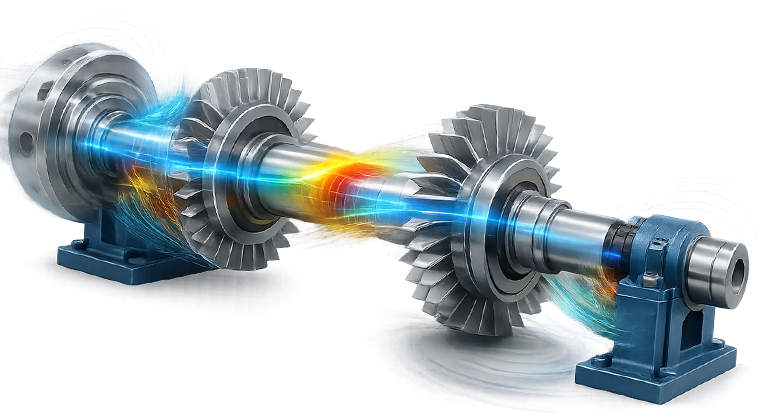
What We Evaluate
Our forced response analyses evaluate how rotor systems respond to real operating forces, including imbalance, harmonic excitation, bearing loads, torque variations, and transient speed changes.
Unbalance Response

Harmonic Excitation

Vibration Amplitude

Startup & Shutdown

Bearing Loads

Transient Response
Why
Forced Response Analysis?
Forced response analysis helps engineers understand how rotating machinery behaves under real operating forces. By predicting vibration amplitudes, bearing loads, resonance risks, and transient response behavior, organizations can reduce vibration problems, improve balancing strategies, protect equipment, and increase rotating machinery reliability.
Applications
- Unbalance Response Analysis
- Harmonic Response Evaluation
- Startup & Shutdown Response
- Bearing & Support Sensitivity
- Balancing & Vibration Reduction
- Failure Investigation
Unbalance Response Analysis
Evaluate rotor vibration caused by mass imbalance to predict response amplitudes, identify sensitive speed ranges, and support balancing recommendations.
Common Applications
- Turbines
- Compressors
- Pumps
- Electric motors
- Fans and blowers
- High-speed shafts
Harmonic Response Evaluation
Analyze rotor response to periodic excitation forces to understand vibration behavior across operating speeds and identify potential resonance conditions.
Common Applications
- Synchronous vibration
- Periodic loading
- Excitation frequency studies
- Resonance screening
- Machine diagnostics
- Rotating equipment design
Startup & Shutdown Response
Assess vibration behavior as machinery accelerates or decelerates through operating speed ranges, including critical speed crossings and transient response events.
Common Applications
- Startup vibration
- Coast-down analysis
- Speed ramp studies
- Commissioning support
- Transient operation
- Field troubleshooting
Bearing & Support Sensitivity
Evaluate how bearing stiffness, damping, support structure behavior, and foundation conditions influence forced vibration response and machine reliability.
Common Applications
- Bearing selection
- Support stiffness studies
- Foundation effects
- Bearing load evaluation
- Support modification
- Vibration reduction
Balancing & Vibration Reduction
Use forced response results to support rotor balancing strategies, reduce vibration amplitudes, and improve machine performance across the operating range.
Common Applications
- Balance plane evaluation
- Correction weight planning
- Vibration reduction
- Field balancing support
- Reliability improvement
- Maintenance planning
Failure Investigation
Investigate vibration-related equipment failures by evaluating whether imbalance, excitation forces, resonance, or transient response contributed to machine damage.
Common Applications
- Excessive vibration
- Bearing failures
- Shaft damage
- Rotor instability
- Resonance investigations
- Root cause analysis